

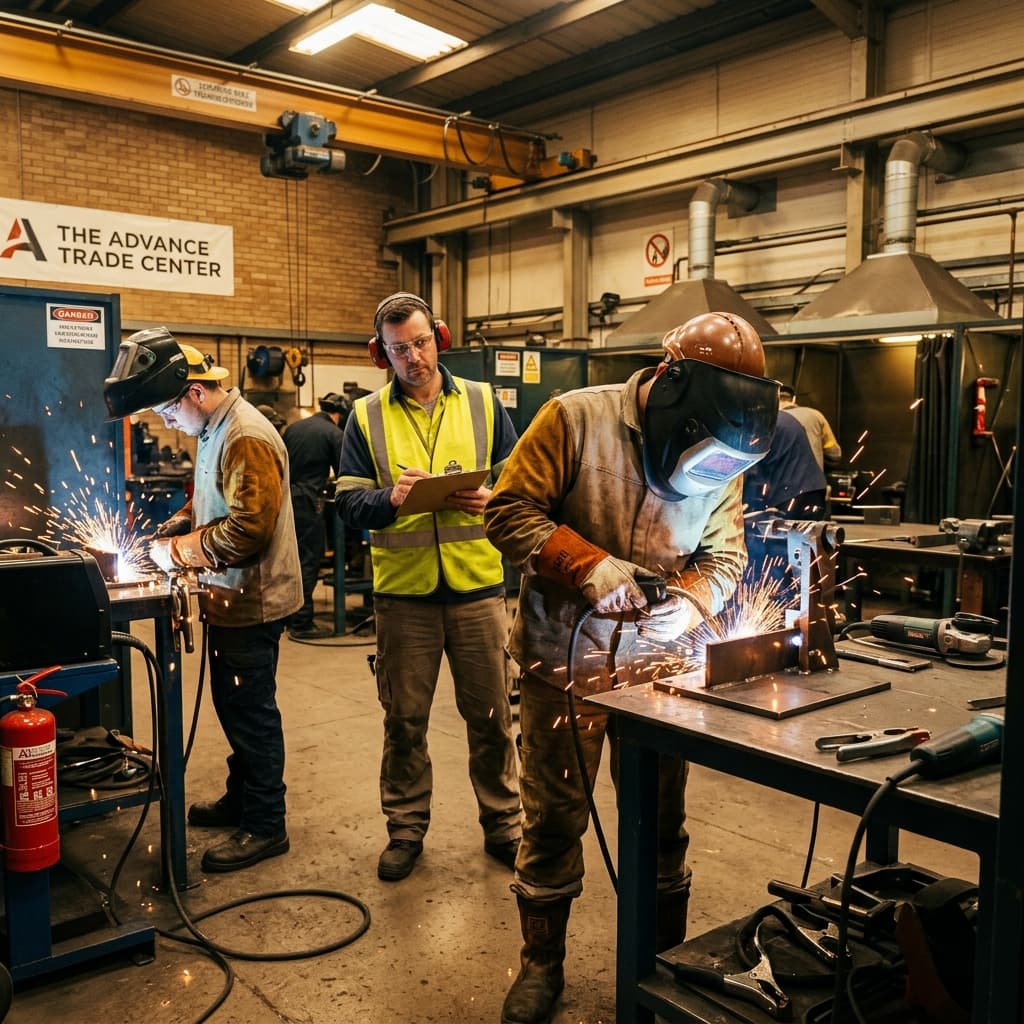
For a listed profession, the Saudi Skill Verification Program is a regulatory requirement: the candidate must pass it before the visa is issued. But SVP is a minimum standard set by the authorities, not your project's specification. An electrician who passes it may still be unsuited to your fire-alarm package; a welder who passes may not qualify to your procedure. The employer's own trade test, run in India before selection, is where you make sure candidates fit the work you actually have. This guide explains how to write a specification that gets you the right workers.
SVP and the Employer Trade Test
- SVP — a standardised assessment, theory plus practical, built on Saudi occupational standards and required for listed professions and recorded on the government platform; our SVP guide explains how it works
- Employer trade test — a practical assessment designed around your project: your materials, your methods, your quality standards; it has no regulatory status but decides who you select
Both are needed for listed trades. The usual order is trade test first, then SVP for the candidates you select, so you are not paying for certification of candidates you will reject.
What a Good Specification Contains
- Role and context — what the worker will do, on what kind of project, at what stage
- Tasks — two to four practical tasks representative of the job
- Materials and tools — what the candidate will use, matching your site where possible
- Time limits — realistic for a competent worker
- Assessment criteria — dimensional accuracy, finish quality, safe behaviour, reading of drawings
- Pass mark or grading — pass/fail or graded, and which grade is acceptable
- Evidence — photographs, video, measurements and assessor notes
Examples by Trade
- Welder — coupons in your process and position, tested visually and by bend test or radiography; see our welders and fabricators page
- Electrician — wiring a distribution board from a diagram, terminating cables and completing an insulation-resistance test sheet
- Plumber — assembling a section of PPR or copper pipework from an isometric and pressure-testing it
- Shuttering carpenter — building a column or wall formwork panel to dimensions, checking plumb and alignment
- Steel fixer — reading a bar bending schedule, then cutting, bending and tying a cage
- Mason — laying a block wall section to line and level
- HVAC technician — brazing a joint, pressure-testing and evacuating a circuit, and diagnosing a set fault
- Heavy equipment operator — a set of manoeuvres plus a productive task such as trenching to a level
- Cook — preparing set dishes in volume within a time limit
- Driver — a practical drive on a comparable vehicle where facilities allow
Making the Test Reliable
- Standardise — every candidate does the same tasks under the same conditions
- Use experienced assessors — tradespeople who have done the work, not recruiters
- Record evidence — video of key steps and photographs of finished work, shared with you
- Calibrate with the employer — at the start, your engineer reviews a sample of tests alongside our assessors, remotely or in person, so standards match
- Re-check before departure — for large mobilisations, spot-check a sample of selected workers
Interviews Alongside the Test
A practical test shows skill; an interview shows experience and attitude. Short video interviews with your site engineer or foreman, covering previous projects, safety practice and understanding of drawings, add a second filter without slowing selection.
Common Mistakes
- Testing a generic version of the trade rather than your work
- Setting pass marks so high that the pool collapses, or so low that the test means nothing
- Not specifying the equipment candidates should be tested on
- Relying on certificates instead of practical tests
- Skipping calibration and then rejecting workers after arrival
Cost and Time
Trade testing adds days, not weeks, to the Indian-side timeline, and its cost should be visible in your agency's per-worker quotation. Specialised tests, such as radiography of welding coupons, carry extra cost and time. Within the 1–25 day timeline, testing runs at the selection stage in parallel with document preparation, so a well-written specification does not delay mobilisation.
Share the Specification Early
Send the trade test specification with the demand letter. The sooner we have it, the sooner sourcing can target candidates who will pass, and the fewer interviews your team spends on people who will not. If you are planning a large crew, read it alongside the large-crew mobilisation guide.
Frequently Asked Questions
Is an employer trade test still needed if the worker has an SVP certificate?
Yes. SVP confirms a regulatory minimum for the profession; your own trade test checks the candidate against your materials, methods and quality standards.
Can we watch trade tests in India remotely?
Yes. Video of key steps and photographs of finished work are shared, and your engineer can join calibration sessions remotely at the start of a requirement.
